
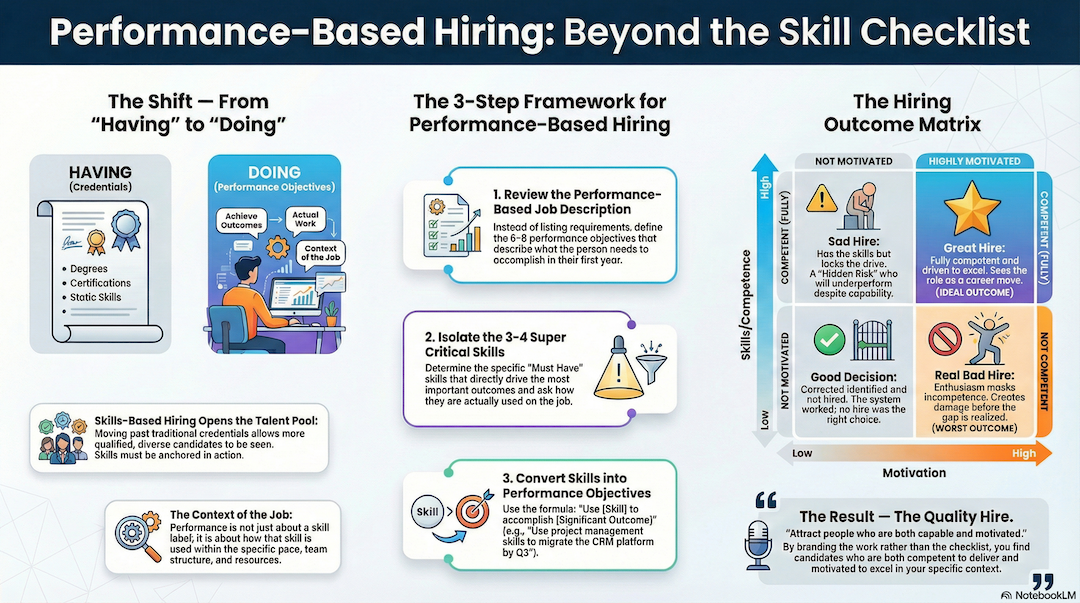
From "Having" to "Doing": Context Is Everything
The critical distinction in performance-based hiring is moving from what a candidate has — degrees, certifications, years of experience — to what they can do with their skills in the specific context of your role.
Skills alone don't predict performance. It's how those skills are applied — within the pace of the team, the available resources, the level of ambiguity, the organizational culture — that determines whether someone succeeds or struggles. This context transforms a generic skill into a measurable performance objective.
Three Steps to Performance-Based Hiring
Making this shift actionable requires a structured approach — one that converts a static wish list of requirements into a predictive hiring model.
Review the Performance-Based Job Description
Instead of listing requirements, define the 6–8 performance objectives that describe what the person needs to accomplish in their first year. Ask: "What does this person need to do to be successful?" — not "What qualifications should they have?"
Isolate the 3–4 Super Critical Skills
Identify the specific "Must Have" skills that directly drive the most important outcomes. Then define them by how they're actually used on the job — the context, the constraints, the expected results. Skills without context are just noise.
Convert Skills into Performance Objectives
Use the formula: "Use [Skill] to accomplish [Significant Outcome]." For example: "Use data analysis skills to build the executive dashboard that tracks our three KPIs by end of Q2." This becomes the basis for both the job posting and the interview.
Why this matters for attraction, not just assessment: When you describe the work in terms of outcomes and impact, you attract people who are excited by the challenge — not just people who match a checklist. The job posting itself becomes a motivation filter.
Competence × Motivation = Hiring Success
The goal isn't just finding someone who can do the work — it's finding someone who wants to do it in your specific environment. The Hiring Outcome Matrix maps every hiring decision across two dimensions: competence and motivation.
Great Hire — The Goal
Fully competent and intrinsically motivated by the specific challenges, team dynamics, and context of the role. Driven to excel. Sees the position as a genuine career move.
Sad Hire — The Hidden Risk
Has the skills but lacks the drive. Can do the job but doesn't want to do it under these conditions. This is the most common and most dangerous hiring trap — it looks fine on paper until engagement craters.
Real Bad Hire — Worst Outcome
Highly motivated but not competent. Enthusiasm masks incompetence. Creates damage while appearing to perform — the costliest mistake because it takes the longest to detect.
Good Decision — Correctly Filtered
Identified as not the right fit and not hired. The system worked. This is what a well-designed process produces — confident "no" decisions, not just hopeful "yes" decisions.
What This Looks Like: Before & After
Here's the same role — a VP Marketing hire — defined two different ways. One attracts résumé matchers. The other attracts performers.
• MBA preferred
• Experience with marketing automation
• Strong leadership skills
• Excellent communication
The second version does two things the first can't: it lets strong candidates self-select ("That's exactly the kind of challenge I want"), and it gives you a concrete basis for evaluating every candidate against the same outcomes.